
护士小葵
Bespoke tailor experiences top foreign tourists’ Shanghai travel list_我的网站

A |

Chinese artificial intelligence (AI) technology companies are gaining a growing foothold among international users, with their models topping rankings on some leading industry platforms, ahead of their US counterparts.
Chinese AI companies, with their open-source strategies and cost effectiveness, are gaining growing adoption among overseas developers despite the continued US restrictions on China's access to advanced chips and AI technologies, a Chinese veteran industry analyst said, noting that global AI competition should be about innovation capabilities and the ability to build attractive ecosystems, rather than about who can erect higher technological barriers.
The latest weekly large-language model (LLM) rankings from AI model aggregation platform OpenRouter showed that models developed by Chinese companies swept the top four spots and took six of the top 10, the Global Times noted on the platform on Tuesday. DeepSeek V4 Flash 0731 topped the ranking with 9.39 trillion tokens in usage, followed closely by Tencent's Hy3 with 8.94 trillion.
From August 3 to Sunday, Chinese AI models recorded 34.25 trillion tokens in usage, up 21.76 percent from the previous week, while US AI models, although up 109.36 percent, only recorded 9.17 trillion tokens, about three times less than that of Chinese models.
Another DeepSeek model, V4 Flash 0423, came in third, followed by Xiaomi's MiMo-V2.5 in fourth place. Zhipu AI's GLM 5.2 and DeepSeek V4 Pro also made the top 10.
Notably, usage of the top-ranked DeepSeek V4 Flash 0731 surged 302 percent over the week. The rankings are based on actual model usage on OpenRouter, highlighting the growing adoption of Chinese AI models among global developers and their strong presence on the platform, Xiang Ligang, director-general of the Zhongguancun Modern Information Consumer Application Industry Technology Alliance, told the Global Times on Tuesday.
Meanwhile, the latest trending rankings on Hugging Face, the world's largest open-source AI community, also highlighted the growing influence of Chinese AI models among global developers. As of Tuesday, four of the top five models on the platform's Trending Models list were linked to Chinese AI companies, with MiniMax's newly released full modality model MiniMax H3 topping the ranking.
One key reason Chinese AI models are gaining popularity is their combination of strong performance, lower costs and greater openness, Chinese experts said.
"Companies such as DeepSeek, MiniMax and Zhipu AI have released open-weight models that developers can download, customize and use to build their own applications. Many Chinese models also come with relatively low API and inference costs, making them more affordable for start-ups and smaller businesses," Xiang said.
According to UBS estimates cited by media reports, leading Chinese AI models cost about one-tenth as much to train as comparable overseas models, while their API prices are typically only 10 percent to 20 percent of those of foreign alternatives.
"China's strong industrial foundation in power supply, computing infrastructure and data center development also provides solid support for the large-scale deployment of AI," said Xiang.
In contrast to many large US AI companies that primarily offer their flagship models through closed platforms and application programming interfaces, China's are gaining traction among global developers with its open model approach, Ma Jihua, a veteran industry analyst, told the Global Times on Tuesday.
The open model approach allows a much broader range of developers, including smaller players, to participate in AI development rather than leaving advanced AI capabilities concentrated in the hands of a few large companies, said Ma. As more developers build on these models, they can create new tools and applications, further expanding the ecosystem around Chinese AI models, Ma added.
China's recently released Action Plan for Global AI Governance explicitly encourages the joint development of international open-source AI communities, greater international exchanges and cooperation among open-source communities, and the sharing of general purpose large models, foundational algorithms and software tools.
Recently, the US government has ramped up its unilateral moves targeting China's AI-related sector, including a plan to ban cutting-edge Chinese AI models, US media outlets have reported.
The growing influence of Chinese AI models shows that technological blockades cannot hold back innovation and industrial development, Ma said, noting that such restrictions could instead backfire by raising costs for US companies and limiting their access to competitive technologies and global AI cooperation.
Chinese AI models are already seeing growing adoption among US businesses. Chinese AI models now consistently account for more than 30 percent of weekly token usage by US companies, with the share peaking at 46 percent, the People's Daily reported, citing data from a third party industry platform.
The US should view the development of China's AI industry objectively, and avoid politicizing or overstretching the concept of national security in normal technological and industrial competition, Ma said.
"After all, global AI competition should ultimately be about innovation and the ability to build attractive ecosystems, rather than about who can erect higher technological barriers," Ma noted.
。

B |
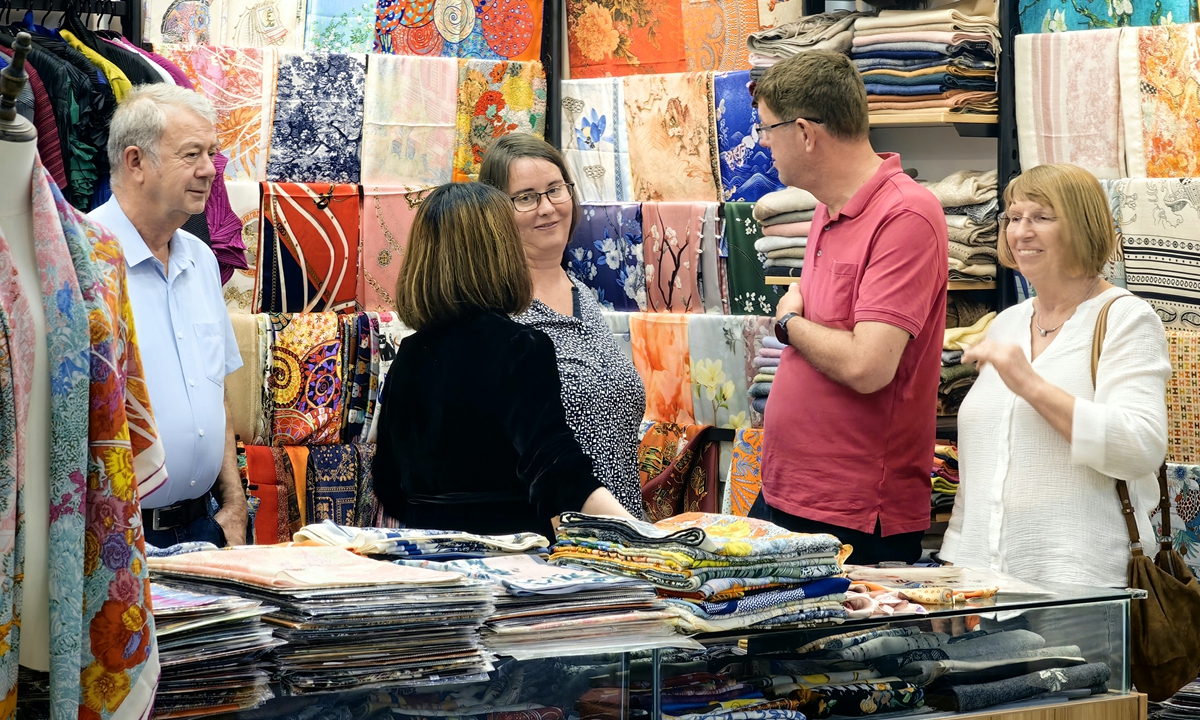
For many overseas travelers arriving in Shanghai, the Bund and the Oriental Pearl Tower are no longer the first stops on their itineraries. Instead, they head straight to the South Bund Soft Spinning Material Market, where custom-tailored outfits have become a signature experience driving "Chinamaxxing," a viral lifestyle trend popular among global travelers.
The market buzzed with energy, with conversations in various foreign languages echoing across storefronts, when a Global Times reporter visited it on a work day.
Tourists from different countries take body measurements, browse design references, and discuss tailoring preferences with local shopkeepers.
Evolving from the time-honored Dongjiadu cloth market, the area now hosts more than 280 fabric vendors and tailor studios, forming a complete industrial ecosystem for custom apparel.
Inside one local shop, two foreign tourists excitedly tried on a series of Tang-style garments, taking photos of their favorite looks before professional tailors record precise measurements for their custom-fit clothing.
Gabbo, an Italian traveler, told the Global Times that he first discovered the market through TikTok and Instagram. As silk markets in Shanghai have grown popular among Italian tourists, he and his travel companion Nicco came specifically to shop for authentic traditional Chinese garments and premium silk pieces.
"I picked out a brown Tang-style jacket and a white shirt, while Nicole got matching white shorts. We wanted to try something new and plan to wear our custom outfits out tonight because the styles are very fashionable," Gabbo said. "The bespoke measuring service is professional and thoughtful, and the whole shopping experience has been wonderful."
Intl tourists emerge as a major force
Benefiting from China's visa-free policy covering Italy, the pair only needed to submit standard tourist documents for entry. They plan to stay in China for roughly two weeks to explore local culture and lifestyles.
Local tailor shop owners have witnessed a striking surge in overseas customer demand. Driven by expanded visa-free policies and viral social media exposure, growing numbers of foreign tourists come to the market for original Chinese-style custom clothing.
According to shop owner Li, international visitors now account for 30 to 40 percent of her clientele, a dramatic reversal from previous years when domestic customers dominated orders.
"We source fabrics directly from suppliers and hire in-house tailors to eliminate middleman markups. Our bespoke pieces cost only one-third of similar custom outfits in Western countries," Li explained. The shop also offers expedited services tailored for short-stay travelers, allowing visitors to pick up finished garments within days.
All garments feature original in-house designs that retain classic Tang-style outlines with soft, wearable color tones suitable for daily wear. Many foreign customers style the traditional jackets with casual trousers and sneakers, creating unique, modern outfits that blend Eastern aesthetics and Western casual fashion, Li said.
Qian, another tailor with 20 years of industry experience, has also seen robust growth in overseas orders, with her annual order volume rising 20 percent year-on-year.
Most foreign visitors come for custom-tailored suits and enjoy the full immersive bespoke production process. Her workshop divides labor for suits, shirts and dresses to boost efficiency, once completing a full set of custom clothes and delivering them to a tourist's hotel by 10 p.m. on the very day of ordering. The studio also accepts personalized design drafts brought by international visitors.
Backed by the mature textile supply chain of the Yangtze River Delta, hand-tailored suits at the market cost merely one-quarter of equivalent bespoke outfits in Europe, with 24-hour rush order services available. This year, market foot traffic has increased roughly 30 percent year-on-year, with foreign shoppers making up 60 percent of all customers, the Global Times learned from the market.
Behind the change are China's visa-free policies. China's 240-hour visa-free transit policy covering 55 countries has greatly facilitated cross-border travel. Official data shows China received 22.91 million inbound foreign visits in the first half of 2026, a year-on-year increase of 20.4 percent, China Media Group reported.
From short-term visits to lasting influence
Boosted by China's visa-free policies, the social media trend "Chinamaxxing" has gone viral worldwide. Easier cross-border travel has allowed young foreigners to immerse themselves deeply in authentic Chinese lifestyles, including traditional fitness practices, Chinese dramas and local food culture.
Beyond garment customization, Shanghai's inbound tourism experience sector continues to expand. Spring Travel recently launched hands-on traditional snack workshops for foreign visitors, focusing on wonton and spring roll making. Tourists can cook, taste homemade snacks and learn the cultural stories behind local cuisine.
The workshops have received visitor groups from the US, Brazil and Australia and earned wide praise, the Global Times learned from Spring Travel.
Sugiurat Akuto, one foreign participant, said that making Shanghai snacks left him with precious travel memories. Before leaving China, he asked chefs for original recipes, hoping to recreate authentic Chinese delicacies at home and share his unique Shanghai travel experience with family and friends.
Unlike disposable souvenir purchases during routine sightseeing, custom-tailored clothes and learnable cultural skills turn short travel experiences into enduring cross-cultural connections. "These custom outfits will remain precious memories for decades. Even 20 years later, we will still remember custom-tailoring clothes in China. Every time I see these garments in my wardrobe, I will recall this special trip," Gabbo said, adding that distinctive local custom pieces are far more valuable than ordinary travel souvenirs.
Industry analysts note that the Chinamaxxing phenomenon marks a structural upgrade in China's inbound tourism consumption. Driven by optimized visa policies, foreign travelers are shifting from superficial landmark sightseeing to high-value, personalized immersive experiences. Longer stays and upgraded consumption drive coordinated growth of modern service industries and inject new vitality into China's service economy.
Research by the Shanghai Municipal Commission of Commerce shows that inbound tourists who opt for customized consumption stay an average of six to seven days in Shanghai, more than double the city's average 3.21-day stay for general foreign visitors.
Current cultural tourism experiential products represent only the initial stage of this emerging industry. China's rich cultural resources can be continuously developed into high-quality, replicable tourism offerings for global audiences, Zhang Yi, CEO of iiMedia Research, told the Global Times on Tuesday.
Most importantly, the Chinamaxxing trend boosts people‑to‑people exchanges. One‑off on‑site travel purchases translate into steady overseas demand and repeat orders, helping international audiences gain deeper insight into China's charm, Zhang noted.
。
Current article:http://nodoo.qiuergejiaolaiaozhuangshi.buzz/news/20260826_9990.html
Published on:15:58:27